Enrico Magnani
PARADISE
L'AMOR CHE MOVE IL SOLE E L'ALTRE STELLE
Italian Institute of Culture
496 Huron Street,
TORONTO
8th December - 4th March 2027
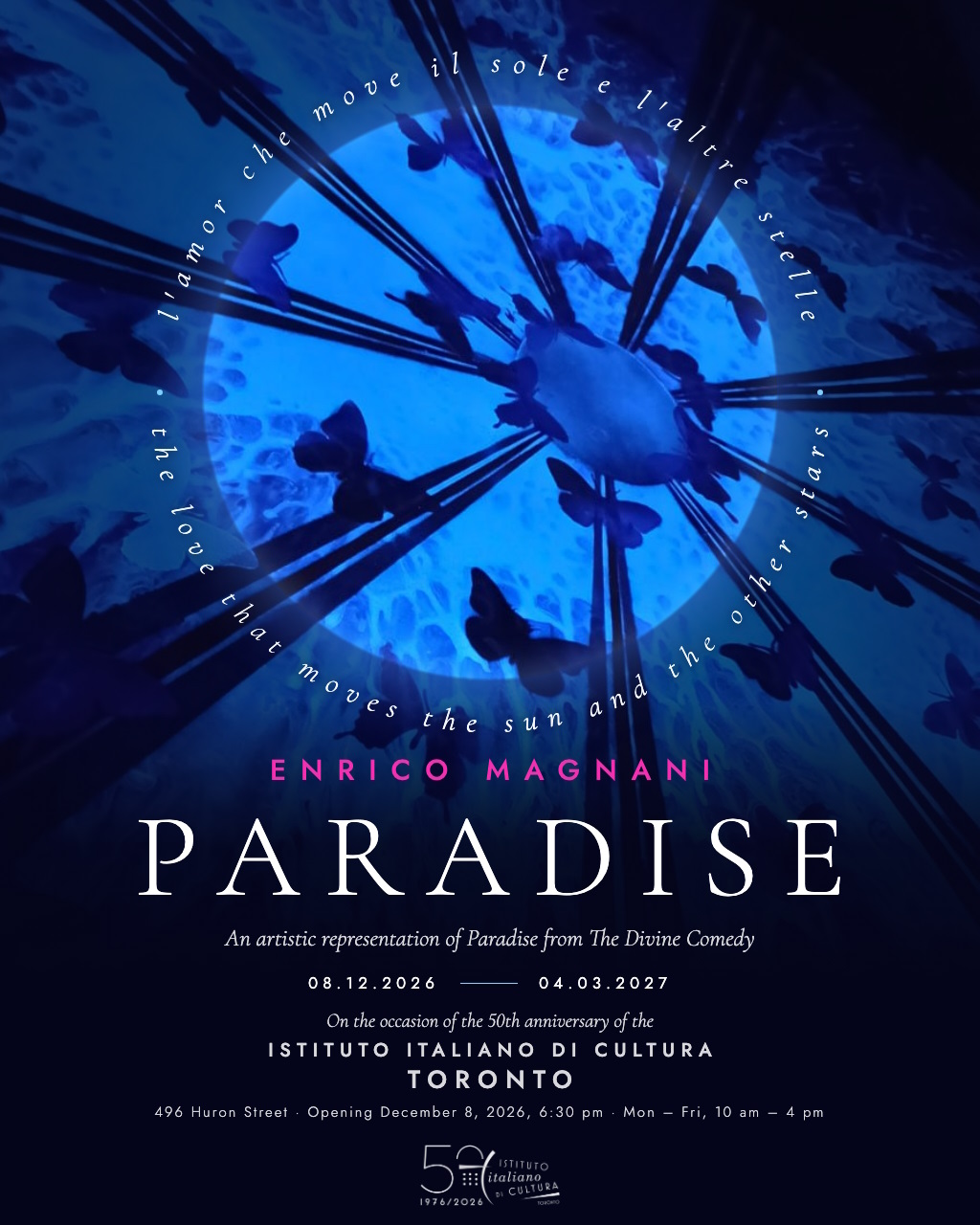
an artistic representaione of PARADISe from the DIVINe comedy
To mark the 50th anniversary of the Italian Cultural Institute of Toronto, Italian artist Enrico Magnani presents the world premiere of the Paradise Cycle: ten works, one for each of the ten Heavens of Dante's Paradise, from the Heaven of the Moon to the Empyrean. PARADISE – The love that moves the sun and the other stars opens on Thursday, December 10, 2026, at 5 pm at the Institute, 496 Huron Street, and runs until February 10, 2027.
Ten Heavens, one butterfly
The cycle sets out to translate into forms and colours the third canticle of the Divine Comedy, the one Dante himself often declared beyond words. It is neither a philological commentary nor a literal illustration. Where the poem gives precise indications, Magnani follows them: the moon as a reflection and a pearl, the sun as concentric rings, Mars as a luminous cross, Saturn as a golden staircase, the Empyrean as a pure white rose. Where the text is silent, the artist interprets, seeking the visual solution closest to the atmospheres the poet describes.
The common thread is the butterfly. In Greek, psyche means both "soul" and "butterfly": the souls of the blessed become butterflies arranged in circles, crosses, ladders and the figure of the eagle, while Dante and Beatrice rise from Heaven to Heaven towards the light. Some butterflies fly out of the circle of their own Heaven in a trompe-l'œil effect, a reminder that they all return, in the end, to the Empyrean.
In the Paradise Cycle two cosmologies meet: the medieval one of crystalline spheres and today's, made of supernovae and dark matter, with which the artist has been in dialogue for years.

