The Cycle of ParadiseIl Ciclo del Paradiso
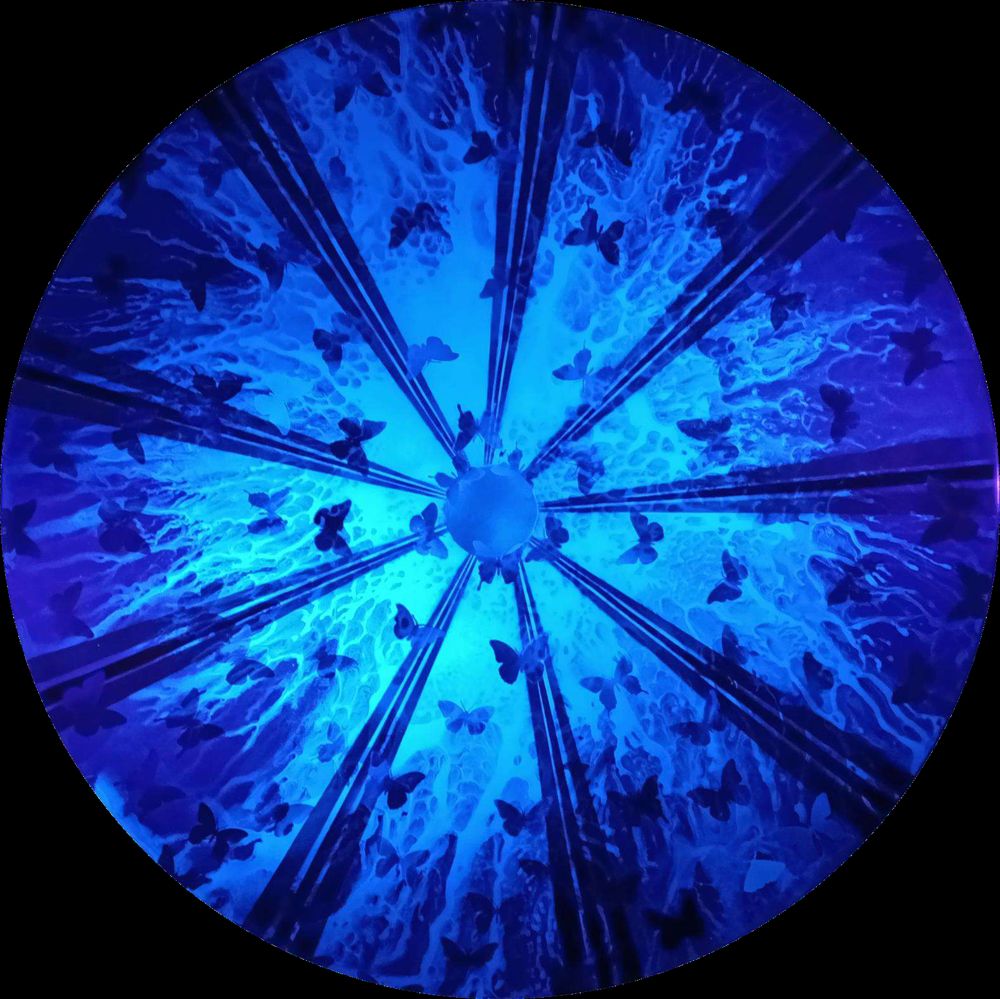
Ten works, one for each of the ten Heavens, in an attempt to render in visual form what Dante described in words – and often declared to be indescribable. Alongside the works, the preparatory sketches trace the evolution of the Paradise project: how each Heaven grew from its first idea into the finished work.
The Cycle of Paradise is a free artistic interpretation, not a philological commentary. Where the poem offered precise indications I sought to remain faithful to them: the moon as a reflection and a pearl, the sun as concentric rings, Mars as a luminous cross, Saturn as a golden staircase, the Empyrean as a pure white rose. Where the text was silent, I filled in the gaps, seeking the visual solution best able to preserve its meaning without betraying its spirit.
The butterfly winds its way through the ten Heavens like a silent thread. In Greek, psyche means both “soul” and “butterfly”: what Dante recounts is not a journey amongst the planets, but a journey of the soul towards its origin.
Enamels, acrylics and fluorescent pigments give each work a second face, which lights up under ultraviolet light: the light of Paradise is not a mere feature of the landscape, but the very substance of things. Each work must therefore be viewed twice: once in daylight and once in the dark.
Dieci opere, una per ciascuno dei dieci Cieli, per provare a restituire in forma visiva ciò che Dante ha descritto con la parola – e che spesso ha dichiarato indicibile. Accanto alle opere, i bozzetti preparatori raccontano il percorso evolutivo del progetto Paradise: come ogni Cielo è passato dall’idea iniziale alla realizzazione finale.
Il Ciclo del Paradiso è una libera interpretazione artistica, non un commento filologico. Dove il poema offriva indicazioni precise ho cercato di rimanervi fedele: la luna come riflesso e perla, il sole come corone concentriche, Marte come croce luminosa, Saturno come scala dorata, l’Empireo come rosa candida. Dove il testo taceva, ho interpolato, cercando la soluzione visiva che meglio potesse custodirne il senso senza tradirne lo spirito.
La farfalla attraversa i dieci Cieli come un filo conduttore silenzioso. In greco psyché significa insieme «anima» e «farfalla»: ciò che Dante racconta non è un viaggio tra i pianeti, ma un viaggio dell’anima verso la propria origine.
Smalti, acrilici e pigmenti fluorescenti danno a ogni opera un secondo volto, che si accende sotto la luce ultravioletta: la luce del Paradiso non è un accidente del paesaggio, ma la sostanza stessa delle cose. Ogni opera va dunque guardata due volte: alla luce del giorno e al buio.
Enrico Magnani
Tap any work below to see it the way it glows in the dark.Tocca un’opera qui sotto per vederla come si accende al buio.